E20 · Kastrup — Lernacken
Sixteen kilometres in three sections
Pick a section: the tunnel, the island, the high bridge and both approaches each have their own rules, speed limits and quirks.
Kilometre 0
Kastrup approach, Amager
The E20 leaves Copenhagen east of the airport and dips underground shortly afterwards. Coming from the city, you reach the tunnel portal in ten minutes.
Kilometre 0–4
Drogden Tunnel
4.05 kilometres of immersed tunnel under the shipping channel — so that shipping stays clear and the Kastrup flight path is not disturbed. Two tubes for the road, two for the railway.
Kilometre 4–8
Peberholm
The artificial island was built from the spoil of the tunnel trench. It was deliberately left unplanted: whatever grows there arrived on its own. Only researchers may set foot on it.
Kilometre 8–16
The high bridge
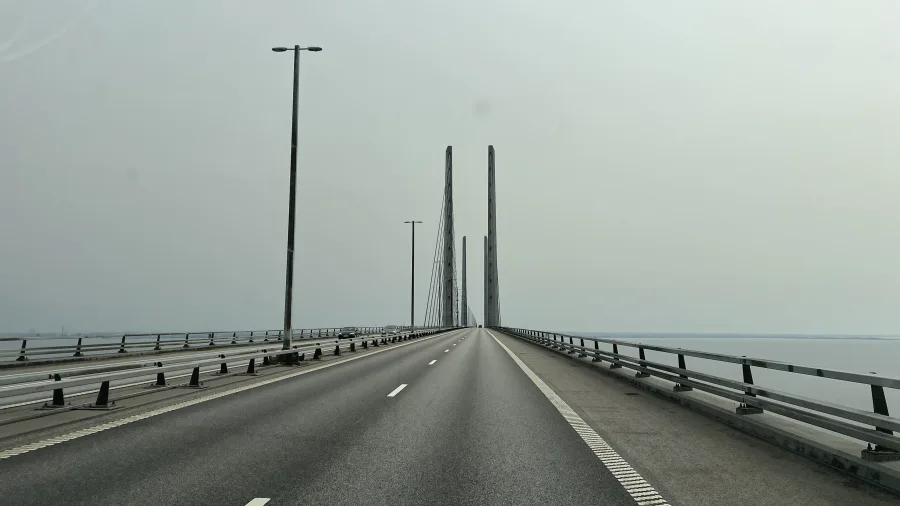
7.85 kilometres of cable-stayed bridge with a 490-metre main span and pylons 203.5 metres tall. The road runs on top, the two tracks below inside the truss.
Kilometre 16
Lernacken and the toll station
The payment point follows on the Swedish side: plate recognition, transponder or cashier. Then Malmö begins, and five minutes later you are in the centre.
Driving up from Germany
The classic route runs across the Little Belt (toll-free), over the Storebælt bridge and on along the E20 to Copenhagen. Two toll points, two pricing systems, one continuous motorway.
Alternatively you cross by ferry on Puttgarden–Rødby or Rostock–Gedser. Combined tickets exist for both routes, bundling the ferry and the bridge toll.
After the bridge
The toll station sits on the Swedish side at Lernacken — heading for Sweden, you pay after the crossing, not before. With plate recognition or a transponder you roll through without stopping.
From Lernacken it is five minutes to central Malmö and roughly two and a half hours to Gothenburg.
Via Puttgarden–Rødby you save the Great Belt toll and around two hours of driving through Jutland. Scandlines sells the ferry and the bridge toll together.